Addis Ababa, September 18, 2026 — Ethiopia could be heading into the strongest El Niño event ever recorded, participants heard at a high-level policy conference jointly organized by the Ethiopian Economics Association (EEA), the Policy Innovation Research Center (PIRC), and the Embassy of the Republic of Poland at the Skylight Hotel in Addis Ababa.

A section of the conference participants at the Skylight Hotel, Addis Ababa
Presenting a detailed analysis titled “Dry Spells, Hard Bells: El Niño and Ethiopian (African) Agriculture,” Solomon Zena Walelign (PhD), economist and Executive Director of PIRC, warned that the forecast 2026–27 El Niño is predicted to be more severe than the devastating 2015–16 event — painting a worrying picture for Ethiopian agriculture and the wider economy.

Solomon Zena Walelign (PhD) during the presentation
El Niño, a periodic warming of the Pacific Ocean, alters weather patterns around the world. For Ethiopia, the greatest danger is the failure of the main Kiremt rains (June–September) across the northern and central highlands — the country’s cereal belt.
The economic consequences could be severe. New PIRC modelling of a “Super El Niño” scenario projects a 6.7% drop in agricultural output, a 1.6% loss in GDP, and an 8.1 percentage-point increase in food poverty. Nor does the damage stop at the farm gate: drawing on research by Ayele, Ejigu and Walelign (2023), the presentation showed the shock rippling through firms and households well beyond agriculture. “If the rains fail, the economy stalls,” Walelign said. “We are seeing that the effect does not stop with farming; it hits sales, jobs, and productivity across the board.”
The presentation also recalled hard lessons from the last major event. The 2015–16 El Niño left 10.2 million Ethiopians in need of food assistance and cost the wider region billions of dollars. National cereal output fell by 15–20%, losses reached 40% in the worst-hit zones, and milk production dropped by 25%, according to assessments by the FAO (2016), FEWS NET (2016), and Abebe and Alem (2025). The current forecast, Walelign cautioned, suggests the coming event could be worse.
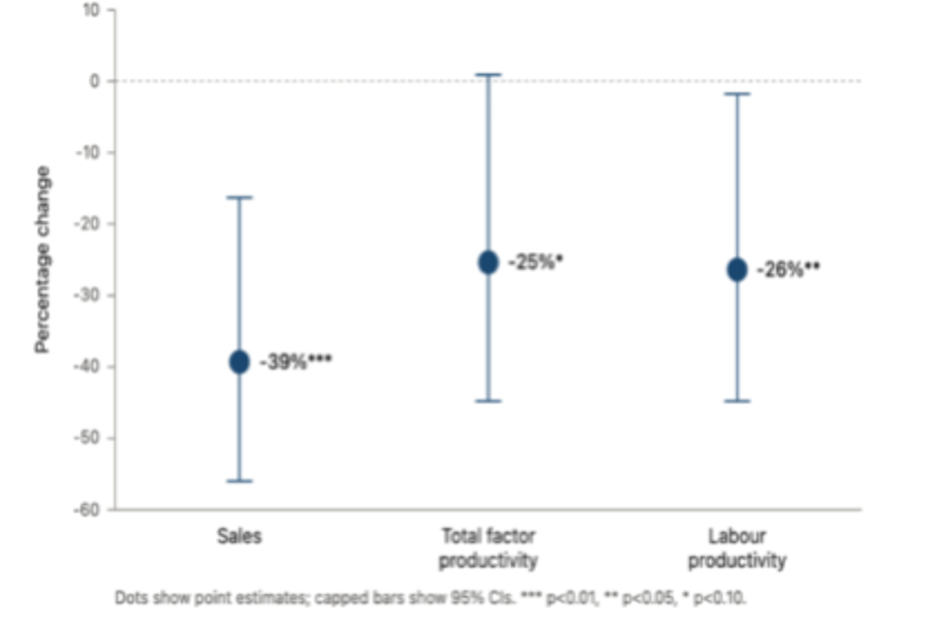
The shock beyond the farm: estimated effects on sales, total factor productivity and labour productivity. Source: Ayele, Ejigu and Walelign (2023)
Ethiopia’s readiness, the analysis showed, has critical gaps. Only 5% of the country’s farmland is irrigated, against a global average of 21%; social protection spending remains low; and agricultural insurance is almost non-existent, at just 0.01% of agricultural GDP.
There was good news, too: early action works. The analysis finds that a combined policy package — cash transfers, irrigation investment, and strategic food reserves — could reduce the projected GDP loss by 36% and cut the poverty impact by 54%.
“The El Niño effect is obvious, but are we ready?” Walelign asked the audience. “We need to build an economy resilient enough to absorb these shocks.”